

Over 1.1 million organizations worldwide hold ISO certification. But what does that certification actually verify, and why do businesses pursue it? This guide explains what ISO certification is, how it works, its eight core uses, and what the process looks like, with specific context for businesses operating in Qatar.
What is ISO Certification?
ISO certification is formal, independent confirmation that a business’s processes meet a globally recognized standard set by the International Organization for Standardization (ISO), an independent, non-governmental body that develops frameworks for quality, safety, environmental management, information security, and other operational areas.
Certification is not self-declared. To become ISO certified, a company undergoes an audit by an accredited, independent third-party certification body. The audit verifies that the organization actually applies the relevant standard consistently, not just on paper. This is the key distinction between ISO compliance (following the standard internally) and ISO certification (having that compliance independently verified and documented by an accredited auditor) , only the latter results in a certificate you can present to clients, tenders, or regulators.
Standards are created by international expert committees and reviewed roughly every five years, which is why they’re trusted consistently across more than 170 countries.
Most Common ISO Standards
- ISO 9001 — Quality Management Systems (QMS)
- ISO 14001 — Environmental Management Systems
- ISO 45001 — Occupational Health & Safety
- ISO 27001 — Information Security Management
- ISO 22000 — Food Safety Management
Each standard serves a different purpose, but they share a common goal: improving organizational performance and building stakeholder trust.ue purpose but shares the common goal of improving organizational performance and stakeholder trust.
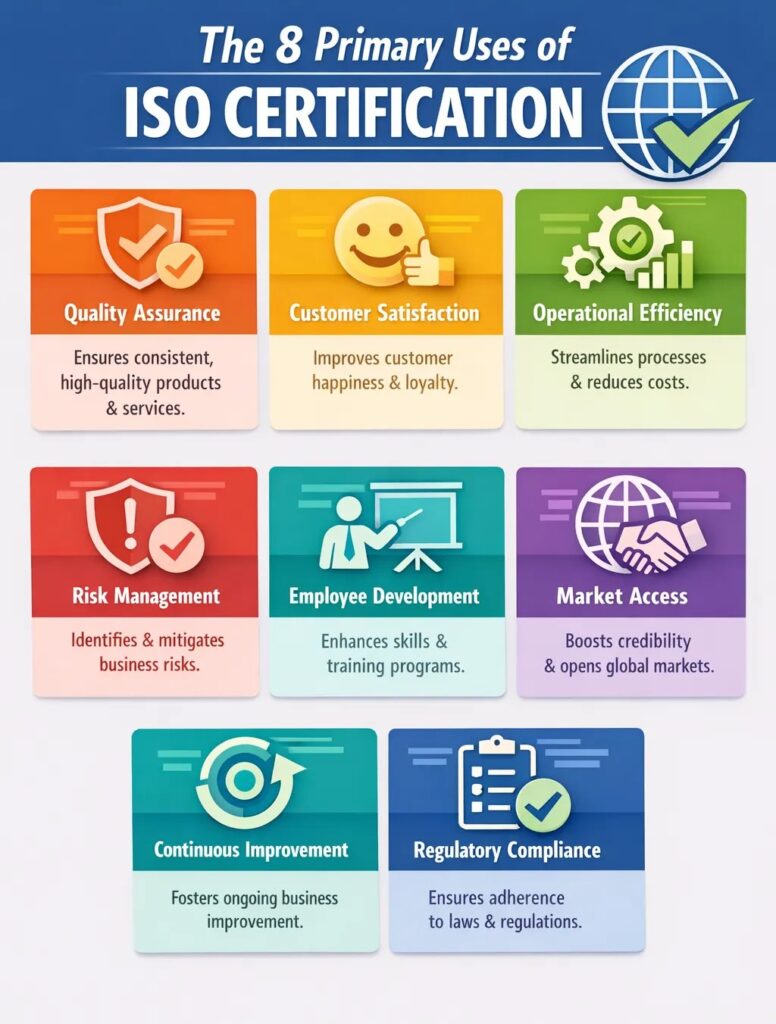
The 8 Primary Uses of ISO Certification
Understanding the purpose of ISO certification involves looking at its real-world applications in business. These eight main uses show how ISO standards provide clear benefits for organizations in various industries.
1. Quality Assurance and Consistency
ISO standards bring order to operations. They ensure that products and services are consistently delivered with high quality.
- Standardized procedures cut down on human error and rework.
- Documented workflows keep organizational knowledge intact.
- Predictable outcomes build customer trust.
- Quality checks help catch issues before they reach the client.
2. Enhanced Customer Satisfaction
A customer-focused approach is part of ISO 9001. It helps businesses understand, meet, and go beyond customer expectations.
- Structured complaint handling and feedback systems
- Faster resolution of issues
- Measurable customer satisfaction standards
- Customized improvements based on client input
Result: Happier customers, reduced churn, and improved brand loyalty.
3. Operational Efficiency Improvement
ISO certification encourages organizations to streamline workflows, reduce waste, and improve resource use.
- Leaner processes eliminate redundancy.
- This leads to better allocation of time, staff, and materials.
- It also results in improved coordination between departments.
- Additionally, there is reduced rework and operational downtime.
4. Risk Management and Prevention
The ISO framework takes an active approach to spotting, assessing, and reducing risks.
- It includes risk analysis and prevention tools.
- It improves business continuity planning.
- It ensures compliance with legal and regulatory rules.
- It boosts readiness for audits and inspections.
Benefit: Fewer surprises, smoother audits, and lower legal risks.
5. Employee Training and Development
ISO standards create a clear and supportive setting for employee training and performance improvement.
- It sets defined skill requirements for each role.
- It offers structured onboarding and upskilling programs.
- It provides tools for performance monitoring and evaluation.
- It aids knowledge retention through process documentation.
Outcome: A more skilled, confident, and effective workforce.
6. Market Access and Credibility
ISO certification is recognized in over 170 countries and is often required in both public and private tenders. Many contracts, particularly in government and infrastructure projects across the Gulf region including Qatar, require ISO certification as a basic qualification criterion.
- shows a commitment to quality and reliability.
- opens doors to new contracts and export opportunities.
- builds trust with clients, partners, and investors.
- sets your brand apart from uncertified competitors.
In markets like Dubai and Abu Dhabi, ISO certification increases credibility and contract eligibility.
7. Continuous Improvement Culture
ISO encourages a culture of ongoing improvement, helping your business adapt to changing demands.
- Regular reviews and internal audits.
- Performance metrics and data-driven decisions.
- Root cause analysis and corrective actions.
- Encouragement of innovation within a structured system.
The result is a nimble, forward-thinking organization that improves over time, not just maintains the status quo.
8. Regulatory Compliance and Legal Protection
Staying compliant with industry laws and regulations is easier and more transparent with ISO.
- aligns with sector-specific and government standards.
- provides documented evidence of due diligence.
- reduces liability through proper operational controls.
- ensures audit readiness at all times.
Peace of Mind: ISO certification offers legal safeguards through clear, traceable processes.
How Does the ISO Certification Process Work?
Getting ISO certified generally takes three to six months and follows a consistent shape regardless of which standard is involved:
- Assessment – A gap analysis compares current practices against the standard’s requirements to identify what needs to change.
- Implementation – Policies, procedures, and documentation are developed, and staff are trained on the new processes.
- Certification audit– An accredited, independent certification body audits the organization in two stages: first reviewing documentation, then verifying the systems actually work in practice.
- Ongoing maintenance– Once certified, annual surveillance audits confirm continued compliance, with full recertification every three years.
Only accredited certification bodies can issue a valid ISO certificate, check that any body you work with is accredited by a recognized national or international accreditation body before starting the process, as unaccredited certificates are not recognized in tenders or by regulators.
For the detailed, Qatar-specific version of this process including our timeline for each stage and what documentation is typically required, see our ISO certification services in Qatar page.
Which ISO Standard Does Your Business Need?
A quick comparison of the five most common ISO certifications and their status for businesses in Qatar.
| Standard | What it covers | Who needs it | Qatar status |
|---|---|---|---|
| ISO 9001– Quality Management | Consistent delivery of products and services through documented processes, risk management, and continuous improvement. | Any industry: manufacturing, construction, healthcare, education, services. The most universally required standard. | Required for most government and semi-government tenders in Qatar. |
| ISO 14001 -Environmental Management | Identifying and controlling environmental impact, waste, emissions, and energy use, while maintaining legal compliance. | Construction, oil & gas, manufacturing, logistics, and businesses with large physical operations. | Conditional. Required for large infrastructure and energy projects under Qatar National Vision 2030 targets. |
| ISO 45001 – Health & Safety | Preventing workplace injuries and illness through hazard identification, risk controls, and safety culture. | Construction, oil & gas, manufacturing. any business with on-site operations or a large workforce. | Mandatory in construction and oil & gas under Qatar Labour Law and QatarEnergy contractor requirements. |
| ISO 27001– Information Security | Managing data breaches, cyber threats, access controls, and IT business continuity risks. | IT, fintech, healthcare, banking, and any business handling sensitive customer data or government contracts. | Mandatory for ICT vendors supplying Qatar government entities under the National Cyber Security Framework. |
| ISO 22000– Food Safety | Controlling food safety hazards across the full supply chain from production and processing through to distribution. | Food manufacturers, processors, distributors, caterers, and restaurant chains operating at scale. | Mandatory for food production facilities and required for import/export licences under MOPH Qatar regulations. |
Not sure which standard applies to you? Our team can confirm the right fit for your industry as part of our consultation.
ISO Certification in Qatar: Context That Matters
Qatar’s economy remains heavily weighted toward petroleum and natural gas, which together account for over 70% of government revenue and international standards compliance has become a practical requirement for participating in major government and energy-sector projects. The Qatar National Vision 2030 prioritizes economic diversification, which is pushing ISO certification demand well beyond oil and gas into construction, healthcare, food, IT, and services.
For businesses that have recently completed company formation in Qatar, ISO certification is often the next practical step toward tender eligibility and market credibility, especially for those weighing profitable business ideas in Qatar in regulated sectors.
Three organizations shape how certification works in-country:
- Qatar Standards Organization (QS)– the national standards body ensuring alignment with international ISO requirements.
- Qatar National Accreditation – accredits certification bodies operating in Qatar.
- Qatar Chamber of Commerce– supports businesses pursuing international standards compliance and market access.
Independent, accredited certification bodies such as Bureau Veritas Qatar or SGS Qatar, conduct the actual certification audits. Always confirm a certification body’s accreditation status before engaging them; unaccredited certificates are not recognized for tenders or regulatory purposes.ure ISO certification in Qatar meets both international requirements and local business needs.
What Does ISO Certification Cost?
Cost depends on the standard, your organization’s size, number of locations, and how close your current processes already are to the standard’s requirements. As a general range, small to mid-sized businesses in Qatar typically budget QAR 5,000–25,000 for consultancy, documentation, and certification body fees combined, though this varies by case.
For an exact quote based on your business, see our ISO certification cost breakdown or request a consultation.
Who Benefits Most From ISO Certification?
Service organizations benefit less from process/defect metrics and more from consistency in customer-facing delivery, repeatable experiences that improve retention.
SMEs gain the most proportionally, certification turns informal practices into documented systems, which builds credibility fast and helps smaller businesses compete for contracts against larger, established players.
Large corporations use certification to standardize practices across multiple locations and business units, improving supply chain coordination and stakeholder confidence at scale.
Manufacturers see the most immediate, measurable impact, fewer defects, tighter supply chain efficiency, and direct cost savings from waste reduction.
Conclusion
ISO certification is more than a compliance checkbox, it’s a practical tool for building better operations, winning more contracts, and establishing credibility in competitive markets. The eight uses covered here, from quality assurance and risk management to regulatory compliance and continuous improvement, show how ISO standards deliver measurable value across every type and size of business.
In Qatar specifically, the stakes are higher: whether you’re bidding on government tenders, operating in construction or oil & gas, handling food production, or supplying ICT services to public entities, holding the right ISO standard is often a prerequisite rather than a bonus.
Ready to get ISO certified? Ayam Group provides end-to-end support, from gap analysis and documentation through to audit preparation and certification for businesses across Qatar. Talk to our ISO certification team!
FAQs on ISO Certification
How long does ISO certification typically take?
The certification process usually takes 3-6 months from initial implementation to certificate issuance, depending on organization size and complexity.
Is ISO certification mandatory?
ISO certification is voluntary, but many contracts and market opportunities require it, making it practically necessary for many businesses.
Can small businesses benefit from ISO certification?
Yes, small businesses often see proportionally greater benefits from ISO certification because it helps formalize and improve their processes systematically.
What happens if an organization fails the certification audit?
Organizations can address identified issues and request re-audit. Most certification bodies work with organizations to help them achieve compliance.
How much does ISO certification cost?
Costs vary widely based on organization size and chosen certification body, but most organizations see return on investment within 12-18 months through operational improvements.
What is the difference between ISO certification and ISO compliance?
Compliance means an organization follows a standard’s requirements internally. Certification means an accredited third-party auditor has independently verified that compliance and issued a formal certificate — only certification is recognized externally for tenders, contracts, and regulatory purposes.
Does ISO certification expire?
Yes. Certificates are generally valid for three years, with annual surveillance audits required to maintain validity and a full recertification audit at the end of the cycle.
How do I choose the right ISO standard for my business?
It depends on your industry and goals: ISO 9001 is the universal starting point for quality management, ISO 45001 is essential for construction and safety-critical industries, ISO 27001 suits data-handling businesses, ISO 22000 applies to food businesses, and ISO 14001 addresses environmental impact. See the comparison table above for a full breakdown.
Can a business hold multiple ISO certifications at once?
Yes, and it’s common, many organizations run integrated management systems (e.g., ISO 9001, 14001, and 45001 together), sharing documentation and audit processes where standards overlap.
How do I know if a certification body is legitimate?
Check that the certification body itself is accredited by a recognized national or international accreditation body (such as Qatar National Accreditation). Certificates issued by unaccredited bodies are not recognized in tenders or by regulators, regardless of how the certificate looks.