
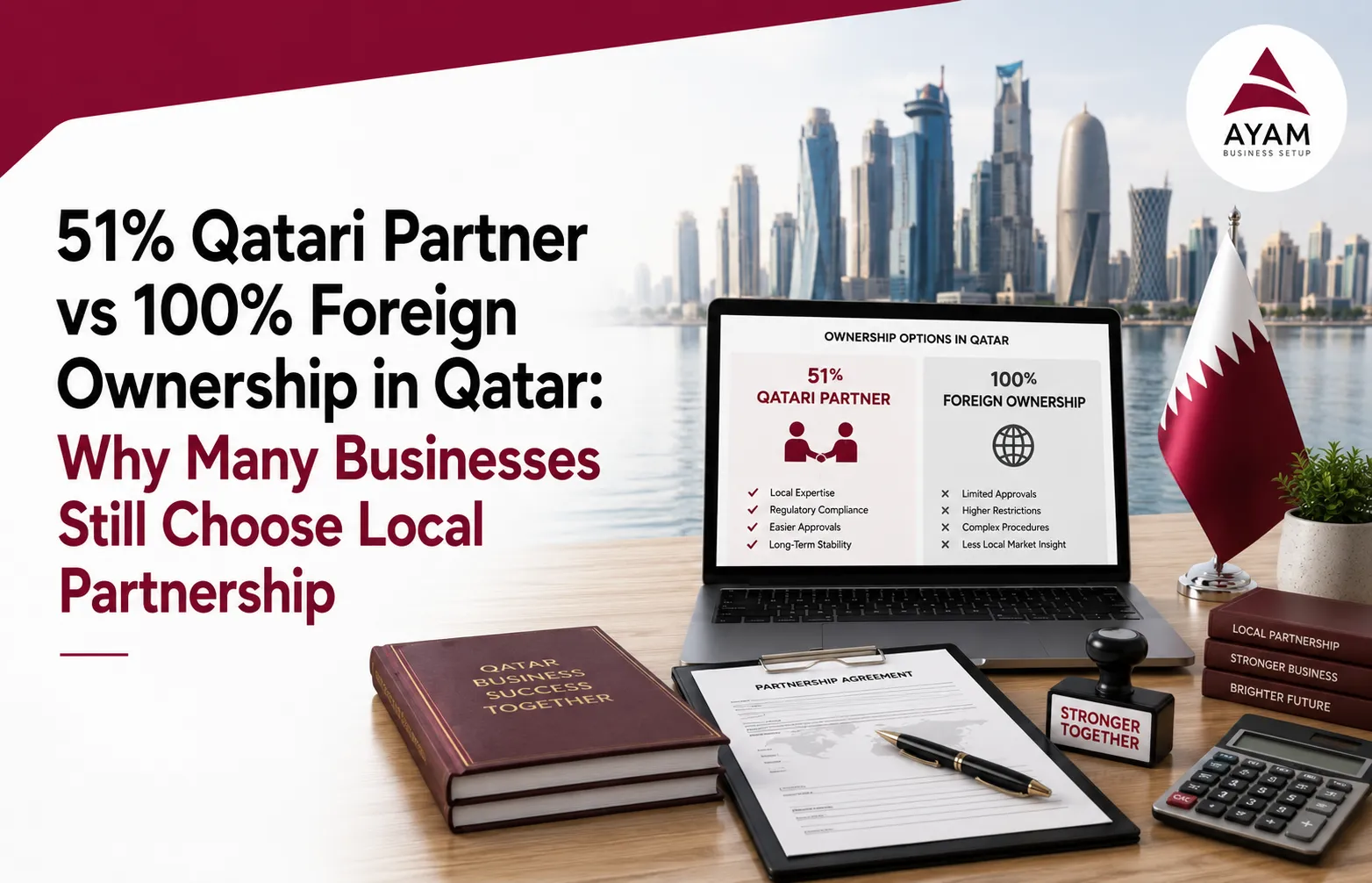
Qatar has become one of the region’s most attractive destinations for foreign investors, largely thanks to reforms that allow 100% foreign ownership in most sectors. On the surface, that makes full ownership the obvious choice. In reality, many established companies and plenty of new entrants still opt for the traditional 51% Qatari / 49% expatriate ownership structure, and not out of necessity.
The reason is simple: ownership percentage is only one part of running a business in Qatar. Day-to-day operations, government relationships, and access to major contracts are shaped just as much by who is on your shareholder register as by how much they own.
Here’s a clear look at why a Qatari partner can still be the smarter structural choice, and how to decide which model fits your business.
Qatar’s Foreign Ownership Law, in Brief
Qatar’s investment framework now permits foreign investors to hold 100% of their company in most commercial and industrial activities, subject to approval from the Ministry of Commerce and Industry (MOCI) and, in some cases, additional sector regulators.
That said, a handful of strategic or regulated activities still require Qatari participation, and several industries continue to see practical, non-legal advantages from having a local partner. So the real question isn’t just “Can I own 100%?”, it’s “What structure will actually serve my company formation strategy best?”
1. Faster Government Approvals
Setting up and operating a company in Qatar means regular contact with multiple authorities, including MOCI, the Ministry of Labour, municipal licensing departments, immigration authorities, and the tax authority.
A Qatari partner or their appointed PRO (Public Relations Officer) or Mandoob, typically already understands how these departments operate, which paperwork gets approved on the first try, and how to resolve issues before they become delays. In practice, this often means:
- Faster Commercial Registration (CR) processing
- Fewer back-and-forth requests on trade license applications
- Quicker establishment card approvals
- Smoother coordination across government departments
For a business trying to get operational quickly, this alone can save weeks.
2. Easier Labor Quotas and Visa Processing
Recruiting international talent is essential for most companies in Qatar, and this is one area where ownership structure genuinely affects outcomes. While 100% foreign-owned companies can absolutely hire expatriates, labor quota requests and visa approvals can involve more scrutiny depending on the business activity.
Companies with Qatari ownership tend to see smoother processing for:
- Work permits and residence permits
- Labor quota approvals from the Ministry of Labour
- Sponsorship transfers
- Broader immigration documentation
For businesses planning to scale headcount quickly, this is often the deciding factor in choosing a local partner and it’s worth pairing with dedicated HR and visa support to keep the process moving.
3. Better Access to Government Tenders and Contracts
If your growth strategy includes public sector work, this is where a Qatari partner matters most. Many government and semi-government entities including organizations like Ashghal and QatarEnergy, either require local ownership or clearly favor bidders who have it.
Companies with Qatari participation typically benefit from:
- Improved eligibility for restricted or preferred tenders
- Stronger positioning during procurement evaluations
- Greater trust among government stakeholders
- Better long-term access to public infrastructure and services contracts
For businesses in construction, engineering, logistics, industrial services, and consulting, tender access can outweigh every other consideration.
4. Local Market Knowledge and Relationships
Business in Qatar, as in much of the Gulf, runs on relationships. A respected Qatari partner brings more than a signature on the shareholder register, they bring insight into local business culture, regulatory expectations, and existing networks that would otherwise take years to build.
That local knowledge can shorten your market-entry timeline and open doors, supplier introductions, industry contacts, or early awareness of upcoming opportunities, that aren’t accessible from outside.
5. Stronger Perceived Credibility
Clients, suppliers, and banks often view companies with local ownership as more committed to the Qatari market for the long term. That perception can quietly influence everything from supplier negotiations to banking relationships to how quickly customers trust a new vendor.
So Is 100% Foreign Ownership Still Worth Considering?
Yes, for the right business. Full foreign ownership remains an excellent fit for international consulting firms, technology companies, holding companies, and export-oriented businesses that don’t rely heavily on government contracts or large-scale local hiring. It’s also the default model inside Qatar’s free zones, which offer:
- Complete ownership and control over strategic decisions
- Independent profit distribution
- Greater operational flexibility with no local partner to coordinate with
The right structure isn’t about which option sounds more modern, it’s about which one matches how your business will actually operate in Qatar.
Questions to Ask Before You Decide
Before choosing between a 100% foreign-owned company and a 51% Qatari partnership, it’s worth asking:
- Will this business deal regularly with government authorities?
- Do you plan to hire a large expatriate workforce?
- Will you bid for government or semi-government contracts?
- Does your industry rely on local networks and relationships?
- Are you building for the long term in Qatar, or running a lighter-footprint operation?
If you answered yes to two or more of these, a Qatari partnership deserves serious consideration, even though you’re legally entitled to full ownership.
How Ayam Group Can Help
Choosing the right ownership structure is one of the most consequential decisions you’ll make when entering Qatar’s market, and it depends entirely on your industry, activity, and growth plans, not a one-size-fits-all rule.
Ayam Group supports investors through every step of business setup in Qatar, including:
- Company formation and Commercial Registration (CR)
- Guidance on 100% foreign ownership eligibility
- Structuring and managing 51% Qatari partnership arrangements
- Free zone company setup for eligible activities
- PRO and government liaison services
- Work visa and HR support
- Ongoing compliance and business support
Planning to start or expand a business in Qatar? Get in touch with Ayam Group’s company formation specialists for a recommendation tailored to your business activity.
Frequently Asked Questions
Is a 51% Qatari partner still required in Qatar?
Not for most businesses. Qatar allows 100% foreign ownership in many sectors, but certain activities still require local participation, and others benefit significantly from having a Qatari partner even when it isn’t mandatory.
Can a 100% foreign-owned company apply for employee visas?
Yes. However, labor quota approvals and immigration procedures can vary depending on the company’s activity and applicable Ministry of Labour regulations.
Does having a Qatari partner actually improve government approvals?
In practice, yes, in many cases. Local partners and their representatives are familiar with MOCI procedures and can help avoid common delays.
Can 100% foreign-owned companies bid for government tenders?
Some can, but many public sector tenders including those from bodies like Ashghal and QatarEnergy, require or favor companies with local Qatari participation, depending on the procurement rules and the specific project.
Which ownership structure is better- 100% foreign ownership or 51% Qatari partnership?
There’s no universal answer. The right choice depends on your business activity, target clients, government exposure, and expansion plans. Speak with a business setup consultant to assess your specific situation and get the best fit.