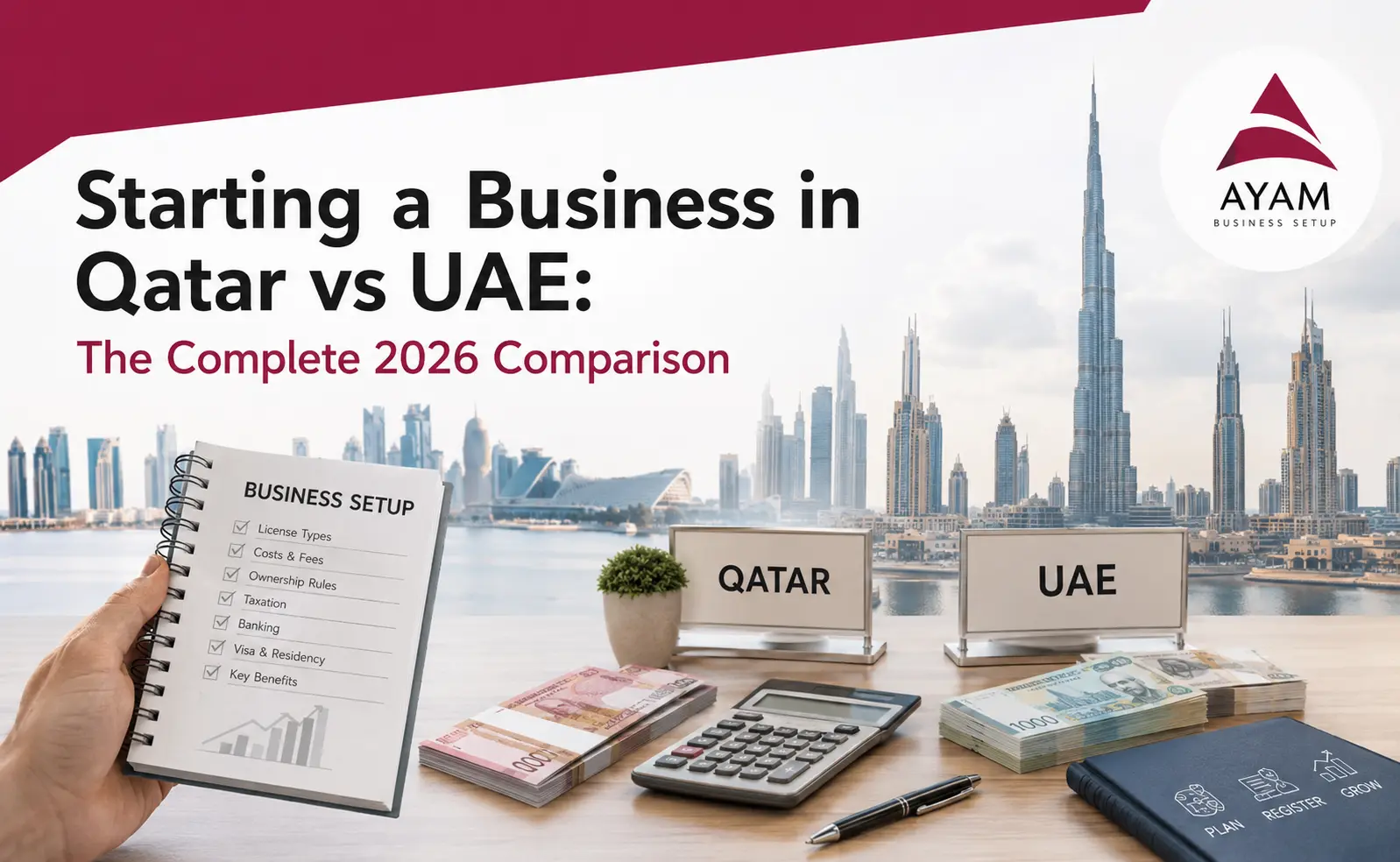
Every week, entrepreneurs ask us the same question: "Should I set up in Qatar or the UAE?"
It’s the right question, and there’s no single right answer.
Both countries offer zero personal income tax, strong infrastructure, and genuine opportunities for foreign entrepreneurs. But they attract different types of businesses for different reasons. The UAE is the region’s largest commercial hub; Qatar is one of the world’s wealthiest nations per capita, with targeted opportunities that are underrated and under-competed.
We’ve been setting up companies in Qatar since 2014 at Ayam Groups. We know the landscape in detail. This guide cuts through the noise and gives you a direct, honest comparison so you can make the right call for your business.
Qatar and UAE Compare at a Glance
| Factor | Qatar | UAE |
| Corporate Tax | 10% (0% in QFC/QFZA) | 9% on profits >AED 375,000 (0% qualifying Free Zone) |
| Personal Income Tax | 0% | 0% |
| VAT | 5% (introduced 2024) | 5% (since 2018) |
| Foreign Ownership (Mainland) | 100% in most sectors (2019 reforms) | 100% since 2021 reforms |
| Free Zone Ownership | 100% (QFC, QFZA, QSTP) | 100% (40+ free zones) |
| Setup Timeline | 7–21 days | 3–21 days |
| Estimated Setup Cost | QAR 15,000–50,000 | AED 10,000–50,000+ |
| Domestic Market | ~3 million | ~10 million |
| GDP Per Capita | Highest in GCC | Top 5 globally |
How Does the Company Formation Process Work in Qatar vs UAE?
Setting Up a Business in Qatar
Qatar offers three primary routes for foreign entrepreneurs:
- Mainland LLC (WLL): The most common structure for businesses trading within Qatar’s domestic market. Since Qatar’s 2019 Investment Law reforms, 100% foreign ownership is available in a growing list of sectors — no local partner required for most activities. The Ministry of Commerce and Industry (MOCI) handles commercial registration, and with an experienced consultant, the process typically takes 7–14 working days.
- Qatar Financial Centre (QFC): Ideal for financial services, consulting, technology, and professional firms. The QFC operates under an English common law framework with its own independent courts and allows 100% foreign ownership. It’s one of the most respected business environments in the Gulf for service businesses.
- QFZA Free Zone: Qatar Free Zones Authority offers 100% foreign ownership, zero corporate tax for qualifying companies, and suits logistics, manufacturing, trading, and technology businesses.
At Ayam Groups, we’ve helped over 1,000 companies navigate all three structures.Get a personalised consultation and we’ll recommend the right route for your specific activity.
Setting Up a Business in the UAE
The UAE offers mainland company registration (100% foreign ownership across most activities since 2021) and over 40 free zones including DIFC, DMCC, Dubai Internet City, and ADGM. Free zone setup can be completed in 3–7 days; mainland registration typically takes 2–4 weeks.
Key difference: The UAE’s free zone ecosystem is larger and more varied. Qatar’s structures — particularly the QFC — are fewer in number but highly prestigious within their niches.
Can Foreigners Own 100% of a Business in Qatar or UAE?
This is where Qatar has made enormous strides that many entrepreneurs still aren’t aware of.
Qatar: The 2019 Foreign Investment Promotion Law opened the majority of commercial activities to 100% foreign ownership on the mainland. Sectors now open to full foreign ownership include trading, retail, construction, manufacturing, IT, healthcare, education, and hospitality. A small number of strategically sensitive sectors still require a Qatari partner. Free Zone and QFC routes have always offered 100% ownership.
UAE: The 2021 Commercial Companies Law amendments similarly opened the mainland to 100% foreign ownership across most activities. Free zones have always permitted full foreign ownership.
Bottom line: Both countries now give foreign entrepreneurs full ownership in most sectors. Qatar’s reforms are newer and less publicised, meaning competition in many sectors is lower than in the UAE.
What Are the Tax Differences Between Qatar and UAE?
Neither country taxes personal income, what you earn is yours to keep. That remains one of the most compelling features of the Gulf for entrepreneurs and business owners.
Corporate Tax
Qatar: A 10% corporate tax applies to foreign-owned mainland businesses. Qatari-owned businesses pay no corporate tax. Companies operating within the QFC or QFZA pay 0% on qualifying income, making free zone registration a strong option for eligible businesses.
UAE: A 9% corporate tax was introduced in June 2023 on profits above AED 375,000. Qualifying free zone businesses that meet substance requirements continue to benefit from 0% tax.
VAT
Both countries apply VAT at 5%. Qatar introduced VAT in 2024; the UAE has had it since 2018.
Withholding Tax
Qatar applies withholding tax on certain payments to non-residents. The UAE has no withholding tax, a meaningful advantage for businesses with international supplier or contractor networks.
Double Tax Treaties
The UAE has over 130 double tax treaties; Qatar has approximately 80. If international tax planning is central to your business model, the UAE’s broader treaty network is an advantage.
Practical takeaway: In free zone structures, both countries can achieve 0% corporate tax. On the mainland, Qatar’s 10% rate is slightly higher than the UAE’s 9%, but the difference is marginal for most businesses.
What Free Zones Are Available in Qatar vs UAE?
Qatar’s Free Zones
- Qatar Financial Centre (QFC): English common law framework, independent dispute resolution, 100% foreign ownership, and a 10% rate on locally sourced profits. Ideal for financial services, asset management, consulting, and fintech. The QFC has attracted major international banks, law firms, and consultancies.
- Qatar Free Zones Authority (QFZA): Located at Umm Alhoul. Suitable for logistics, manufacturing, technology, and trading. Offers 100% foreign ownership, 20-year tax holidays, and customs duty exemptions.
- Qatar Science and Technology Park (QSTP): Focused on technology, R&D, and innovation businesses.
Explore your options: Free Zone Company Setup in Qatar.
UAE’s Free Zones
The UAE operates over 40 free zones. DIFC for finance, DMCC for commodities and trading, Dubai Internet City for technology, Jebel Ali for logistics, and ADGM in Abu Dhabi for asset management and family offices.
Verdict: The UAE’s free zone ecosystem is broader. Qatar’s free zones, especially the QFC, are fewer but world-class within their sectors.
How Much Does It Cost to Set Up a Business in Qatar vs UAE?
Qatar Setup Costs
For a typical WLL or Free Zone company in Qatar, total first-year costs including government fees, commercial registration, trade license, and professional consultancy fees generally range from QAR 15,000 to QAR 35,000 (approximately USD 4,100–9,600).
Additional costs to factor in:
- Office address: Required for most license types. Flexible office space in Doha meets this requirement cost-effectively.
- Visa and residency: Our PRO Services handle all visa processing, residence permits, and labour cards.
- Accounting and compliance: Accounting and bookkeeping services keep you compliant from day one.
UAE Setup Costs
UAE free zone licenses start from AED 10,000–15,000 (approximately USD 2,700–4,100) for basic structures. Mainland company setup is generally AED 15,000–50,000 depending on activity and emirate.
Which Country Offers the Better Market and Business Opportunity?
Qatar’s Market Opportunity
Qatar has a population of approximately 3 million, but the real opportunity is concentrated and high-value:
- Energy sector access: Qatar is the world’s largest LNG exporter. Businesses serving QatarEnergy, its contractors, and supply chain are accessing one of the most valuable procurement ecosystems on the planet.
- Government infrastructure spending: Qatar’s National Vision 2030 drives sustained public investment across construction, technology, healthcare, and education — creating a continuous stream of tender opportunities.
- Highest GDP per capita in the GCC: Qatar’s population is small, but its purchasing power is exceptional.
- Lower competition: Fewer businesses are registered in Qatar than the UAE, which means less-crowded markets and stronger margins across many sectors.
Best fit for Qatar: Energy services, construction, engineering, professional services, healthcare, education, and businesses supplying government or QatarEnergy.
UAE’s Market Opportunity
The UAE’s population of approximately 10 million, combined with its function as a regional hub for the Middle East, Africa, and South Asia, gives it unmatched breadth. Businesses based in Dubai routinely serve markets across two billion people in the surrounding region.
Best fit for UAE: Consumer-facing brands, e-commerce, logistics, fintech, media, and businesses using the UAE as a regional launchpad.
Who Should Choose Qatar — and Who Should Choose UAE?
Qatar Is the Better Choice If:
- You serve the energy sector. QatarEnergy’s supply chain and contractors represent billions in annual procurement. No other Gulf location gives you this proximity and access.
- Government contracts are your market. Qatar’s Vision 2030 infrastructure pipeline — hospitals, roads, smart city projects — creates ongoing tender opportunities for qualified businesses.
- You want less competition. Qatar has fewer registered companies and better available margins in many industries precisely because fewer competitors have made the move.
- You value economic stability. Qatar’s sovereign wealth fund (QIA) manages approximately USD 450 billion. The country carries no external debt and runs a budget surplus.
- Your customers are in Qatar. If your clients are Qatari government entities, QatarEnergy, or the local market, a registered Qatari entity is essential.
Ready to explore Qatar? Start with a consultation from Ayam Groups, we’ll assess your activity, recommend the right structure, and give you a transparent cost estimate within 24 hours.
UAE Makes More Sense If:
- You need regional scale. If your business model requires broad access across the Middle East, Africa, and South Asia, the UAE’s hub function is unmatched.
- You’re in consumer-facing or high-volume sectors. Retail, hospitality, media, and e-commerce benefit from the UAE’s larger domestic population and 17 million+ annual tourists.
- Setup speed is the priority. UAE free zone licenses can be issued in 3–5 days for straightforward structures.
- You’re in global financial services. DIFC is the unrivalled financial centre of the Middle East, with a concentration of international banks, law firms, and an English common law framework.
Final Verdict — Qatar or UAE for Business in 2026?
There isn’t a universal winner, only the right fit for your business.
The UAE wins on breadth: bigger consumer market, more free zone options, faster setup, and stronger regional hub connectivity. For businesses that need scale, consumer volume, or regional access, it’s the stronger base.
Qatar wins on depth: the world’s highest GDP per capita, extraordinary access to energy sector opportunities, lower market competition, and exceptional fiscal stability. For businesses in energy, construction, professional services, healthcare, or education ,Qatar’s opportunity is significant and far less contested.
Our view, built from 10+ years of setting up companies in Qatar: too many entrepreneurs overlook Qatar because the UAE’s marketing reach is louder. The businesses that have established themselves here have done very well precisely because the market isn’t crowded.
Ready to Set Up Your Business? Here’s How Ayam Groups Can Help
Ayam Groups has been Qatar’s leading business setup consultancy since 2014. We’ve helped over 1,000 companies register and operate in Qatar — from solo entrepreneurs to large international corporations.
- Company Formation (WLL/LLC) — Full MOCI-compliant mainland registration in 7–14 days
- Free Zone Company Setup — QFC, QFZA, QSTP — 100% foreign ownership, zero corporate tax
- PRO Services — Visas, residence permits, labour cards, government liaison
- Office Space in Doha — Flexi-desks, private offices, and virtual addresses
- Accounting & Bookkeeping — Stay compliant from day one
- Trademark Registration — Protect your brand in Qatar
- ISO Certification — 250+ companies certified across ISO 9001, 14001, 45001, and more
Frequently Asked Questions
Is it easier to start a business in the UAE or Qatar?
The UAE is faster and more straightforward to set up in — free zone licenses can be issued in 3–5 days, and the entire process is well-documented and widely understood. Qatar has improved significantly but typically takes 7–21 days. That said, “easier” doesn’t mean “better.” Many sectors in Qatar are less competitive precisely because fewer people have made the move, which means higher margins for those who do. If your business fits Qatar’s market, the extra few days of setup is a worthwhile trade-off.
If I set up in Qatar, can I still do business in the UAE — and vice versa?
A Qatar-registered company can trade internationally, including with UAE clients, without restriction. However, if you want to physically operate, bid on UAE government contracts, or maintain a UAE presence, you’d need a separate UAE entity. The same applies in reverse — a UAE free zone company cannot trade directly in Qatar’s domestic market without a local presence. Some businesses set up in both jurisdictions; our team can advise on whether that makes sense for your specific model.
Which is better for a freelancer or solo consultant — Qatar or UAE?
The UAE has a more developed freelance infrastructure: multiple free zones issue individual freelance permits (Creative Zone, SHAMS, Meydan) at relatively low cost. Qatar doesn’t have an equivalent freelance permit structure — solo operators typically need to set up a proper company entity (WLL or QFC). If you’re a solo consultant wanting the lightest possible structure, the UAE is currently the more practical option. If your consulting work is specifically for Qatari clients or QatarEnergy, a Qatar entity is necessary regardless.
What happens if my business fails — how easy is it to close a company in Qatar vs UAE?
Company liquidation in both countries requires settling all liabilities, cancelling visas, closing bank accounts, and deregistering with the relevant authority. In Qatar, the mainland WLL liquidation process can take several months. QFC company closure is generally more streamlined. In the UAE, free zone company closures are typically faster and better documented. This is a genuine UAE advantage that’s worth factoring in if you’re still at the “testing the market” stage.
Can I live in Qatar on the back of my own company’s visa?
Yes. As a business owner registered in Qatar, you’re entitled to a residence permit sponsored by your company. This gives you legal residency, allows you to open a bank account, rent property, and sponsor family members. The residence permit is renewable as long as your company remains active. Note that Qatar’s residency system is tied to your company’s status — if the company is cancelled, the residency falls away.
Is Qatar’s business environment actually improving, or is it still difficult for foreigners?
It has improved meaningfully. The 2019 Investment Law, the QFC’s expansion, and the QFZA’s development have all made Qatar substantially more accessible than it was five to ten years ago. Qatar recorded USD 2.74 billion in foreign direct investment in 2024 across 241 projects — a real indicator of growing foreign business confidence. That said, cultural context still matters: relationships, patience, and understanding local business norms remain important. It’s not as plug-and-play as a UAE free zone, but it’s no longer the closed market it once had the reputation of being.