
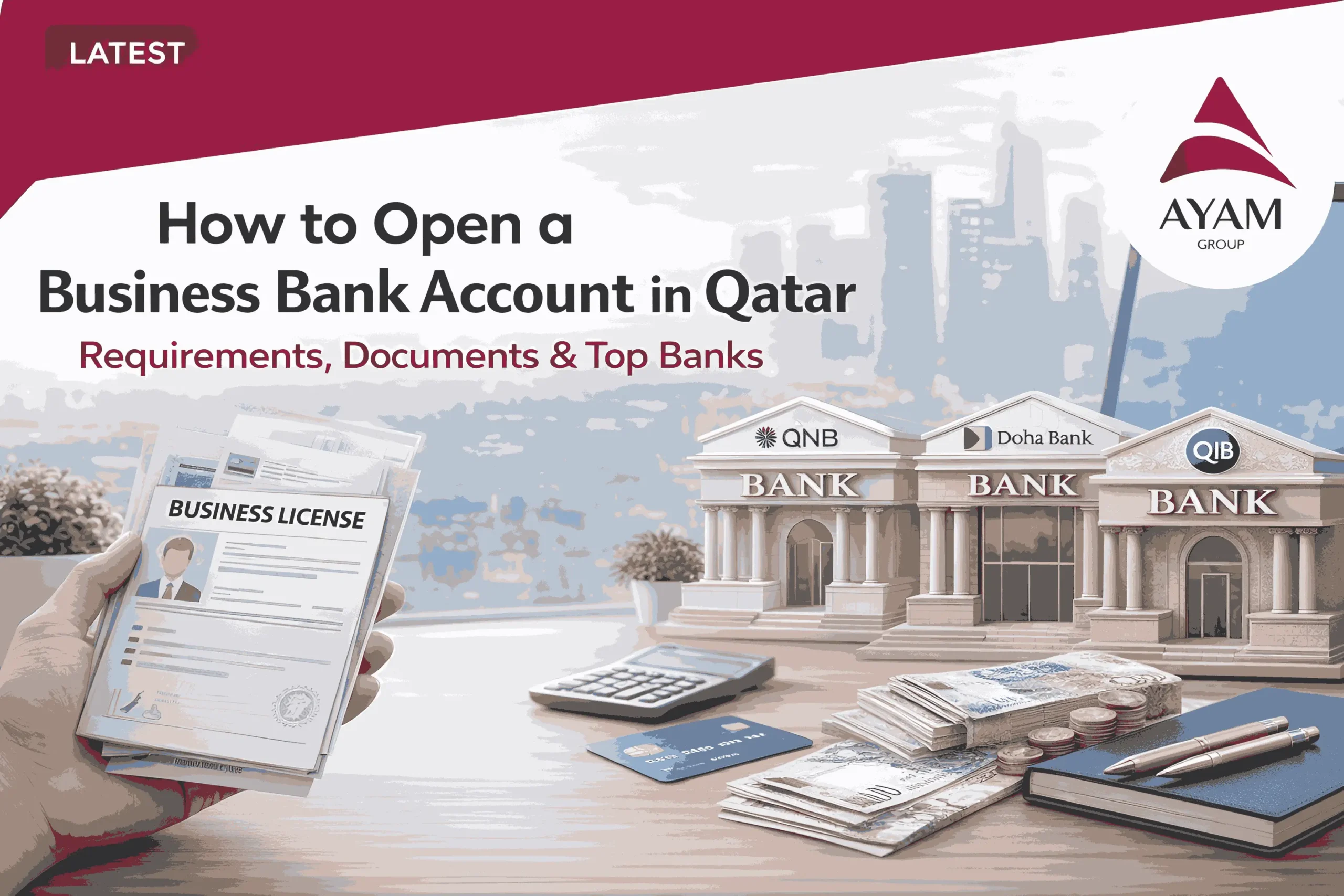
Setting up a business in Qatar is one of the smartest moves you can make as an entrepreneur in the Middle East. Qatar’s economy is stable, investor-friendly, and growing at a remarkable pace, driven by a diversified national vision that extends well beyond oil and gas. But before your company can operate, pay suppliers, process payroll, or accept client payments, you need one critical thing: a dedicated business bank account.
Opening a corporate bank account in Qatar involves more steps and documentation than a personal account. Requirements vary depending on your business structure, the bank you choose, and whether you are a resident or a foreign investor. This guide walks you through everything you need to know, from Qatar business bank account opening requirements and documents to the best banks, timelines, and how to get approved without unnecessary delays.
Why You Need a Business Bank Account in Qatar
A dedicated corporate bank account is not just a formality in Qatar, it is a legal and operational necessity.
Legal Compliance: Qatar’s regulatory framework requires registered businesses to hold a separate corporate account for all financial transactions. Mixing personal and business funds can create legal complications and damage your company’s credibility with auditors, partners, and government bodies.
Payroll Processing: Under Qatar’s Wage Protection System (WPS), businesses must pay employee salaries electronically through a registered bank account. Without a corporate account, you cannot legally process payroll. Read more about WPS compliance on the Qatar Ministry of Labour’s official website.
Client and Vendor Payments: Corporate clients, government entities, and large vendors in Qatar typically require payments from a registered business account, not a personal one.
Access to Business Finance: Trade finance, letters of credit, overdraft facilities, and business loans are only available to businesses holding a verified corporate account with a licensed Qatari bank.
International Transactions: A Qatar business bank account gives your company the ability to conduct international wire transfers, manage foreign currency transactions, and deal confidently with overseas suppliers and clients.
Eligibility: Who Can Open a Business Bank Account in Qatar?
Before gathering your documents, confirm that your business structure qualifies.
Locally Registered Companies: Any company registered with Qatar’s Ministry of Commerce and Industry (MOCI) — including LLCs, sole proprietorships, and branch offices is eligible to open a corporate bank account.
Free Zone Companies: Companies established in Qatar’s free zones such as the Qatar Financial Centre (QFC) or Manateq zones are eligible, though some banks may require additional free zone registration documents. Learn more about free zone company setup in Qatar and how it affects your banking options.
Foreign Companies with a Qatar Branch: Foreign companies must first establish a registered branch or representative office in Qatar. Banks do not open accounts for foreign entities without a local presence. See our full guide on how to start a business in Qatar as a foreigner to understand your options before approaching a bank.
Startups and New Businesses: Newly incorporated companies can open a temporary account to deposit minimum share capital during the registration process, later converted to a fully operational account. If you are at the formation stage, our company formation in Qatar service ensures your documentation is bank-ready from day one.
Qatar Business Bank Account Opening Requirements: Documents Checklist
This is the most important part of the process. Banks in Qatar strictly follow Know Your Customer (KYC) and Anti-Money Laundering (AML) guidelines set by the Qatar Central Bank (QCB). Incomplete documentation is the single biggest reason applications are delayed or rejected.
Company-Level Documents
- Commercial Registration (CR) – Proof of registration with MOCI; the primary document banks require
- Trade License – Confirms your business is legally authorized to operate in its activity area; mandatory for all applications. If your license is due for renewal, here is how to renew your trade license in Qatar before you apply.
- Memorandum and Articles of Association (MOA/AOA) – Outlines ownership structure, shareholding pattern, and management authority
- Computer Card – Issued by MOCI; used by government bodies and banks to electronically verify your company’s registration details
- MOCI Approval Letter – Required for foreign-owned businesses; confirms authorization to conduct business in Qatar
- Bank’s Company Profile Form – A bank-issued form capturing business activity, expected transaction volumes, and source of funds
- Office Tenancy Agreement – Proof that your business operates from a physical address in Qatar; virtual addresses are generally not accepted
- Ownership Structure Chart – Visual or documented breakdown of shareholding, including beneficial owners and their percentages
- Business Plan / Cash Flow Projections – Required by some banks for newly incorporated companies with no financial track record
- Existing Business Contracts – Copies of active client or supplier contracts to verify the legitimacy of your operations
- Bank Statements from Other Accounts – Six months of statements from previous or existing accounts strengthens your application and speeds up compliance review
Director, Shareholder & Signatory Documents (Individual KYC)
- Valid Passport – Clear copy for every director, shareholder, and authorized signatory
- Qatar ID (QID) – Required for all Qatar-resident individuals associated with the account
- Proof of Address – Utility bill, tenancy agreement, or official document not older than three months
- Professional CV / Background Summary – Some banks require this for directors or signatories to establish business credibility
- Bank Reference Letter – A letter from an existing bank confirming good standing; often required for foreign directors
- Personal or Business Bank Statements – Last three to six months of statements to verify income and financial activity
- Board Resolution for Account Opening– A formal resolution authorizing specific individuals to open and operate the corporate account, naming all authorized signatories
Types of Business Bank Accounts in Qatar
Knowing which account type your business needs helps you target the right product and prepare accordingly.
- Current Account (Checking Account): The standard corporate account used for day-to-day transactions, payments, payroll, and receipts. Most banks require a minimum monthly balance.
- Foreign Currency Account: Ideal for businesses in international trade. Allows USD, EUR, GBP, and other major currency transactions without constant QAR conversion.
- Fixed Deposit Account: Used to park surplus business funds at a higher interest rate for a fixed tenure.
- Trade Finance Account: Gives businesses access to letters of credit, bank guarantees, and documentary collections, essential for importers and exporters.
- Islamic (Sharia-Compliant) Account: Offered by Islamic banks in Qatar for businesses that require Sharia-compliant banking structures.
Top Banks for Business Accounts in Qatar
Qatar’s banking sector is well-developed and internationally connected. Here are the leading options for corporate accounts:
Qatar National Bank (QNB) The largest bank in Qatar and one of the biggest in the Middle East and Africa, QNB was established in 1964. It offers a comprehensive range of corporate banking services including trade finance, treasury solutions, and multi-currency accounts. Approximate minimum deposit: QAR 30,000. Processing time: one to two weeks.
Commercial Bank of Qatar (CBQ) Qatar’s first private bank, founded in 1975, CBQ serves a wide base of SMEs and large corporates. It offers a “New to Qatar” business account option with some flexibility for recently arrived entrepreneurs. Approximate minimum balance: QAR 50,000.
Doha Bank Doha Bank is well-regarded among SMEs for its business-friendly approach and competitive trade finance products. A strong choice for mid-sized businesses with regional operations.
Qatar Islamic Bank (QIB) The go-to option for businesses seeking Sharia-compliant banking. QIB offers a full suite of Islamic corporate banking products including murabaha financing, wakala deposits, and Sharia-compliant trade finance.
HSBC Qatar Part of HSBC’s global network with a presence in Qatar since 1954, HSBC Qatar is the preferred choice for foreign-owned businesses and multinationals requiring cross-border payment services and multi-currency accounts.
Standard Chartered Qatar Standard Chartered provides strong corporate banking services with particular expertise in international trade and treasury solutions, ideal for businesses with operations across multiple countries.
Step-by-Step Process to Open a Business Bank Account in Qatar
Step 1- Register Your Company
Ensure your company is fully registered with MOCI and all licenses are active and valid. If you are still at the formation stage, Ayam Group’s company formation service prepares your documentation to meet both MOCI and bank compliance requirements simultaneously.
Step 2- Choose the Right Bank
Compare banks based on minimum balance requirements, international transfer fees, online banking capabilities, and trade finance offerings. Not all banks are equally suited to every business type.
Step 3- Prepare Your Document Package
Compile all corporate and personal KYC documents as listed in the checklist above. Documents in languages other than Arabic or English must be officially translated. Ayam Group’s legal attestation services and translation services can handle this efficiently.
Step 4 – Schedule an In-Person Appointment
Most banks require a physical meeting to open a corporate account. Contact the bank’s business banking team to schedule an appointment with a relationship manager.
Step 5 – Submit Your Application
Present all documents at the appointment. The bank will conduct an initial review and may ask follow-up questions about your business activity, expected transaction volumes, and source of funds.
Step 6 – Compliance and Due Diligence Review
The bank’s compliance team verifies all documents, checks ownership structures, and screens directors and shareholders against international sanctions and AML databases as required by QCB guidelines. This typically takes one to four weeks.
Step 7 – Compliance Interview (If Required)
Some banks schedule a structured interview to ask additional questions about your business model, revenue sources, and projected cash flows.
Step 8 – Account Activation and Initial Deposit
Once approved, you sign the account-opening forms and make your initial deposit. Online banking access, corporate debit cards, and a checkbook are issued shortly after activation.
Minimum Balance Requirements: Quick Reference
- Qatar National Bank (QNB): ~QAR 30,000 initial deposit
- Commercial Bank of Qatar (CBQ): ~QAR 50,000 minimum balance; QAR 500 fee applies when balance falls below threshold
- Doha Bank, QIB, HSBC, Standard Chartered: Vary by account type and business profile, confirm directly before applying
Note: Minimum balance requirements are subject to change. Always verify the latest figures with your chosen bank directly.
How Long Does It Take?
- Simple applications (complete documents, straightforward ownership): 1–2 weeks
- Complex applications (multiple foreign shareholders, high-risk activity, incomplete documents): 3–6 weeks
The most effective way to reduce processing time is to submit a complete, well-organized document package at the first visit. Our PRO services team at Ayam Group regularly liaises with banks on behalf of clients to keep applications moving.
Common Reasons for Rejection and How to Avoid Them
- Incomplete or expired documents: Ensure every document is current and fully attested before submission
- Unclear source of funds: Clearly document the origin of your initial capital and shareholder contributions
- Address mismatch: Your tenancy agreement address must exactly match your commercial registration address
- Sanctions or AML screening flags: All directors and shareholders will be screened; ensure background information is accurate and consistent across all documents
- FATCA non-compliance: US citizens must complete FATCA self-certification, refusal can result in rejection at several banks
- High-risk business classification: Certain sectors require additional documentation; consult a business setup advisor before applying
How Ayam Group Can Help
At Ayam Group, we have helped over 1,000 entrepreneurs and businesses successfully set up and operate in Qatar over more than a decade. Our team knows exactly what Qatar’s banks require at every stage from document preparation and attestation to direct bank coordination on your behalf.
Our end-to-end Qatar business setup services include:
- Company Formation in Qatar
- Free Zone Company Setup
- PRO Services
- Legal Attestation
- Translation Services
- Accounting and Bookkeeping
Whether you are incorporating a new LLC, expanding a branch, or setting up in Qatar’s free zones, we make sure your corporate bank account application is complete, compliant, and ready to be approved on the first submission.
Final Thoughts
Opening a business bank account in Qatar is entirely straightforward when your company is properly registered and your documentation is complete, consistent, and well-organized. Qatar’s banking sector is highly regulated, internationally connected, and built to support serious business, all of which works in your favor once your account is active.
If you want to skip the trial and error and get your corporate account opened correctly the first time, Ayam Group is your trusted partner in Qatar. Reach out today.
Frequently Asked Questions
Can I open a Qatar business bank account without travelling to Qatar?
Some banks allow initial documentation to be submitted remotely and permit a licensed PRO agent with power of attorney to manage certain steps. However, most banks require at least one in-person visit from a director or authorized signatory for final verification.
What is the minimum deposit required for a Qatar business bank account?
It varies by bank. QNB typically requires around QAR 30,000 while CBQ requires approximately QAR 50,000. Always confirm the latest requirements directly with your chosen bank.
Do I need a trade license before opening a corporate account?
Yes. A valid trade license from Qatar’s Ministry of Commerce and Industry is a non-negotiable requirement for any corporate bank account application in Qatar.
How long does it take to open a business bank account in Qatar?
Between one and four weeks in most cases, depending on document completeness and your company’s ownership structure.
What happens if my application is rejected?
You can formally escalate to the Qatar Central Bank if you believe the rejection was unwarranted. Working with a business setup consultancy to address the specific rejection reasons before reapplying is strongly recommended.
Which type of bank account is best for a small business in Qatar?
A current account is the best starting point for most small businesses in Qatar. It covers day-to-day payments, payroll via the Wage Protection System, and supplier transfers from one place. As you grow, you can add a foreign currency account for international transactions or a fixed deposit for surplus cash. If Sharia-compliant banking matters to your business, Qatar Islamic Bank (QIB) offers current accounts under Islamic finance principles. Focus on low minimum balance requirements and minimal maintenance fees at the start — premium features can wait.
Which bank in Qatar has zero or low fees for business accounts?
No major bank in Qatar offers a completely fee-free business account, but several waive monthly fees when you maintain the minimum balance. QNB waives maintenance fees above ~QAR 30,000. CBQ charges ~QAR 500/month only when the balance drops below QAR 50,000 — stay above it and you pay nothing. Doha Bank and QIB are also competitive for SMEs. Always request a full fee schedule covering transfers, checkbooks, and online banking before committing.