

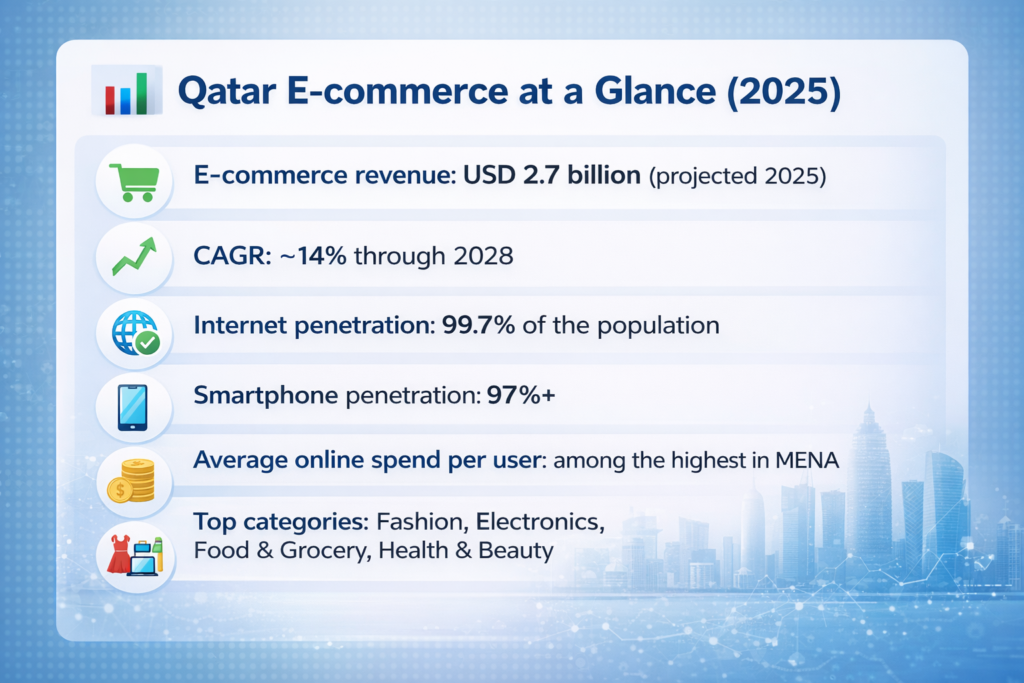
Qatar’s digital economy is growing at breakneck speed. With internet penetration exceeding 99%, a population of tech-savvy, high-income consumers, and a government fully committed to digital transformation under Qatar National Vision 2030, the country has become one of the Middle East’s most attractive e-commerce markets. Whether you’re a local entrepreneur or an international business looking to expand into the GCC, this guide gives you everything you need from incorporation and licensing to logistics, payment gateways, digital marketing, and beyond to launch a profitable online store in Qatar.
Why Start an E-commerce Business in Qatar?
Before diving into the how, let’s understand the why. Qatar is not just another emerging market it offers a unique combination of factors that make it ideal for e-commerce businesses.
- Extremely High Purchasing Power
- Qatar consistently ranks as one of the world’s top nations by GDP per capita. Qatari consumers spend freely online, and expatriates who make up roughly 88% of the population are highly accustomed to digital shopping from their home countries. This creates a multi-cultural, multi-language demand landscape that rewards businesses who target it correctly.
- Government-Backed Digital Economy Push
- The Qatari government actively encourages digital business through Qatar National Vision 2030 and the Digital Agenda 2030. Initiatives like the Qatar Free Zones Authority (QFZA), Smart Qatar (Tasmu), and the Qatar Financial Centre (QFC) all provide streamlined pathways for businesses to operate digitally.
- World-Class Logistics Infrastructure
- Hamad Port and Hamad International Airport are among the most modern in the world. Qatar has heavily invested in last-mile delivery infrastructure, and third-party logistics providers (3PLs) have a strong presence in the country, making fulfilment fast and reliable.
- Low Competition, High Demand
- Compared to Saudi Arabia and the UAE, Qatar’s e-commerce market is still maturing, which means less competition for early movers. Businesses that establish a strong online presence now benefit from reduced customer acquisition costs and stronger brand recognition over time.
- Tax-Friendly Environment
- Qatar imposes no personal income tax and has no VAT (unlike the UAE and Saudi Arabia which have 5–15% VAT). Corporate tax applies only to foreign-owned businesses outside free zones, and even then, rates and structures can be optimised. For e-commerce, this means healthier margins and simpler pricing.
- High Social Media & Mobile Commerce Penetration
- Qatar has one of the highest social media usage rates in the world. Instagram, Snapchat, TikTok, and WhatsApp are dominant platforms that drive purchasing decisions, particularly in fashion, food, and beauty categories. Mobile-first shopping is the norm.
How to Start an E-commerce Business in Qatar: Step-by-Step
Starting an e-commerce business in Qatar involves legal, technical, financial, and marketing decisions. Here’s a comprehensive step-by-step roadmap.
Step 1: Choose Your E-commerce Niche and Business Model
The foundation of every successful online business is a well-researched niche and a clearly defined business model.
1.1 Selecting a Profitable Niche
Use data to validate your niche before investing. The following sectors show consistently strong demand in Qatar:
| Category | Demand Level | Competition | Recommended Approach |
| Fashion & Apparel | Very High | Moderate | Niche targeting (modest fashion, luxury, sportswear) |
| Electronics & Gadgets | High | High | Bundle offers, aftersales service focus |
| Health & Beauty | Very High | Moderate | Arabic/expat-specific products |
| Food & Grocery | High | Growing | Subscription boxes, specialty imports |
| Home & Furniture | High | Low-Moderate | Design-led, customisation angle |
| Baby & Kids | High | Low | Premium international brands |
| Sports & Fitness | Growing | Low | Post-World Cup health consciousness |
| Islamic Products | Moderate | Low | Ramadan, Eid seasonal spikes |
1.2 Business Model Options
- B2C (Business to Consumer): Sell directly to end consumers. Highest volume potential.
- B2B (Business to Business): Sell products or services to other businesses. Higher order values.
- D2C (Direct to Consumer): Manufacturer selling without intermediaries. Stronger margins.
- Dropshipping: No inventory needed; supplier ships directly. Lower risk, lower margins.
- Marketplace Model: Create a platform for other sellers. Higher complexity but scalable.
- Subscription Commerce: Recurring revenue model. Excellent for FMCG, beauty, food.
| 💡 Pro Tip Conduct keyword research using tools like Google Keyword Planner, SEMrush, or Ahrefs targeting Arabic and English search terms in Qatar. Combine this with competitor analysis on platforms like Amazon.ae and Noon to find gaps in the market. |
Step 2: Conduct Thorough Market Research
Market research in Qatar requires understanding a uniquely diverse consumer base made up of Qatari nationals (approx. 12%) and expatriates from South Asia, Southeast Asia, Western countries, and the Arab world.
2.1 Primary Research Methods
- Surveys via Google Forms or Typeform (Arabic + English)
- Interviews with target customers — especially expat communities
- Mystery shopping competitor websites to evaluate UX, pricing, and delivery promises
- Social listening on Instagram, Snapchat, Reddit Qatar, and expat Facebook groups
2.2 Secondary Research Sources
- Qatar Statistics Authority (PSA) — Population and economic data
- Ministry of Commerce and Industry (MOCI) — Business sector reports
- Statista — E-commerce market sizing
- Google Trends — Search demand patterns in Qatar
- Euromonitor / McKinsey MENA Reports — Consumer behaviour insights
2.3 Analysing Your Competitors
Map out every major competitor in your niche. Evaluate:
- Website design and user experience (UX)
- Product range, pricing, and promotional strategy
- Customer reviews and complaints (Google Maps, Trustpilot, social media)
- Delivery times and return policies
- SEO strength — which keywords they rank for
Step 3: Choose Your Business Structure and Register Legally
Qatar has multiple legal pathways for establishing an e-commerce business. The right choice depends on your nationality, ownership preferences, target market, and planned scale.
3.1 Mainland License (Ministry of Commerce and Industry — MOCI)
For businesses operating within Qatar’s domestic market. A mainland license allows you to trade freely with Qatari consumers and government entities. As of 2019, certain business activities allow 100% foreign ownership on the mainland , consult a local legal advisor to confirm eligibility for e-commerce activities.
| Factor | Details |
| Ownership | Up to 100% foreign ownership in approved activities |
| Minimum Capital | QAR 200,000 (approx. USD 55,000) for most activities |
| Trade Name | Must be approved by MOCI |
| Office | Physical address required |
| Timeframe | 4–8 weeks typically |
| E-commerce Activity Code | Must include ‘Electronic Commerce’ under permitted activities |
3.2 Qatar Free Zones Authority (QFZA)
The Qatar Free Zones Authority operates two main zones: Ras Buain and Umm Alhoul. Free zones offer 100% foreign ownership, 0% corporate tax, full profit repatriation, and simplified licensing. Ideal for businesses that want to serve Qatar and export internationally.
| Benefit | Description |
| Ownership | 100% foreign ownership guaranteed |
| Corporate Tax | 0% (exemption for up to 20 years) |
| Profit Repatriation | Full repatriation allowed |
| Customs Duty | Exempt within free zone |
| Workforce | No Qatarisation (nationalisation quota) requirements |
| Best For | Tech companies, logistics, international e-commerce brands |
3.3 Qatar Financial Centre (QFC)
The Qatar Financial Centre (QFC) is ideal for fintech, financial services, and professional services companies that want to operate within Qatar with a robust legal and regulatory framework based on English common law. It’s increasingly popular for e-commerce businesses with complex payment or financial structures.
| Attribute | QFC Details |
| Ownership | 100% foreign ownership |
| Legal System | English Common Law |
| Dispute Resolution | QFC Court / QICCA arbitration |
| Tax | 10% corporate tax on profits (with many exemptions) |
| Target Businesses | Fintech, insurtech, professional services, digital businesses |
3.4 Which License Type Is Right for You?
| Your Situation | Recommended Structure |
| Qatari national or GCC citizen starting locally | MOCI Mainland |
| Foreign investor, selling only to Qatar consumers | MOCI Mainland (with local partner or 100% foreign activity) |
| International brand wanting GCC/global hub | QFZA Free Zone |
| Fintech, payments, financial e-commerce platform | Qatar Financial Centre (QFC) |
| Small business, testing the market | QFZA — lower minimum capital requirements |
| ⚠️ Important E-commerce businesses in Qatar must explicitly include ‘Electronic Commerce’ or ‘Online Retail’ in their licensed commercial activities. Operating online without this licence can result in fines or suspension. Always verify your commercial registration covers digital sales. |
Step 4: Trademark Registration and Brand Protection
Your brand is one of your most valuable assets. Protecting it from day one prevents costly disputes and counterfeiting later.
4.1 Trademark Registration with MOCI
- File your trademark application with the Ministry of Commerce and Industry (MOCI) Intellectual Property Department
- Applications can be filed online through the MOCI portal
- Registration covers 10 years and is renewable
- Cost: Approximately QAR 1,000–3,000 depending on classes
- Processing time: 3–6 months (expedited options available)
4.2 What to Trademark
- Business/brand name (in both English and Arabic if applicable)
- Logo and visual identity elements
- Taglines or slogans used in marketing
- Product names (if proprietary)
4.3 International Protection, Madrid Protocol
If you plan to expand across the GCC or globally, consider filing through the WIPO Madrid Protocol, which allows simultaneous trademark registration in 130+ countries through a single application.
| 💡Pro Tip Always conduct a trademark search before settling on a brand name. Use the MOCI trademark database and the WIPO Global Brand Database to check availability. Rebranding after launch is expensive and damages SEO equity. AYAM Group helps you with reliable and efficient Trademark registration service in Qatar. |
Step 5: Register Your Domain and Build Your Brand Identity
Your domain name is your digital address. It must be memorable, brandable, and — where possible — keyword-rich for SEO purposes.
5.1 Domain Registration Options
| Domain Extension | Best For | Registrar |
| .qa | Qatar-focused businesses; builds local trust | ictQATAR (Supreme Committee for Delivery & Legacy) |
| .com | Global credibility; international reach | GoDaddy, Namecheap, Google Domains |
| .store | E-commerce-specific signalling | Most major registrars |
| .shop | Alternative e-commerce extension | Most major registrars |
| .ae | For UAE-Qatar cross-border businesses | du/Etisalat registered providers |
5.2 Domain Best Practices
- Keep it under 15 characters — shorter is more memorable
- Avoid hyphens and numbers — they create confusion
- Register both .com and .qa versions of your name
- Consider registering common misspellings to prevent traffic loss
- SSL certificate is mandatory — most hosts include this free via Let’s Encrypt
5.3 Building Your Brand Visual Identity
- Logo design: Professional, scalable, works in Arabic and English
- Colour palette: Consider cultural associations (green = growth/Islam; white = purity; gold = luxury)
- Typography: Bilingual fonts that render cleanly in Arabic script
- Brand voice: Define tone of voice — formal, friendly, aspirational, trusted
Step 6: Choose Your E-commerce Platform
Selecting the right platform determines your store’s scalability, performance, and customer experience. There’s no single ‘best’ answer — it depends on your technical ability, budget, and business model.
6.1 Platform Comparison
| Platform | Best For | Qatar Suitability | Arabic Support | Monthly Cost (est.) |
| Shopify | SMEs, fast launch, dropshipping | Excellent | RTL supported | USD 29–299+ |
| WooCommerce | Custom builds, WordPress users | Good | RTL plugins available | USD 10–50+ (hosting) |
| Magento/Adobe Commerce | Large enterprises, complex catalogues | Very Good | Full RTL | USD 500–2,000+ |
| Salla | Arabic-first e-commerce, MENA native | Excellent | Native Arabic | SAR 299–999/month |
| Zid | MENA-focused SMEs | Very Good | Native Arabic/RTL | SAR 199–799/month |
| BigCommerce | Mid-market, multi-channel | Good | RTL available | USD 29–299+ |
| Custom Build | Unique needs, full control | Depends | Fully custom | USD 10,000+ build |
6.2 Essential Platform Features for Qatar
- Arabic language support with proper Right-to-Left (RTL) rendering
- Qatar Riyal (QAR) currency display
- Multi-currency support for international customers
- Integration with local payment gateways (see Step 8)
- Mobile-optimised design — 80%+ of Qatar shoppers are on mobile
- Local shipping integration (aramex, DHL, Qatar Post)
- WhatsApp and social commerce integrations
| 💡 Pro Tip For Arabic-first markets, Salla and Zid are purpose-built for MENA e-commerce and handle Arabic SEO, RTL layouts, local payment gateways, and compliance out of the box. For global brands entering Qatar, Shopify with an Arabic theme is the fastest path to launch. |
Step 7: Source Your Products and Manage Inventory
Product sourcing and inventory management are make-or-break for profitability in Qatar’s e-commerce market.
7.1 Local Sourcing
- Qatar-produced goods (limited but premium branding opportunity)
- Doha wholesale markets — especially Electronics Street (Al Nasr area) and Al Meena Port area
- Local manufacturers and craftsmen (artisan products, Arabic goods)
7.2 International Sourcing
- China/Asia: Alibaba, AliExpress, 1688 for mass-market products
- Turkey: Growing fashion and textile supplier for MENA region
- Europe/USA: Premium goods for the luxury segment
- India: Spices, textiles, jewellery, electronics components
7.3 Dropshipping in Qatar
Dropshipping is legal and growing in Qatar. Key considerations: ensure your supplier can deliver to Qatar within acceptable timeframes (customers expect 3–5 days for standard delivery), and confirm that Customs duty on imported goods has been factored into your pricing. Qatar’s import duty rates vary by product category (typically 5% on most goods, 0% on essential items).
7.4 Inventory Management Best Practices
- Use cloud-based inventory management software (Zoho Inventory, TradeGecko, Odoo)
- Implement SKU tracking from day one
- Set reorder points to avoid stockouts during peak periods (Ramadan, National Day, Eid)
- Consider 3PL (third-party logistics) fulfilment centres in Qatar or UAE for fast delivery
Step 8: Set Up Payment Gateways and Financial Systems
Qatar’s payment landscape has matured significantly. Customers expect multiple payment options, seamless checkout, and bank-grade security.
8.1 Preferred Payment Methods in Qatar
| Payment Method | Usage | Notes |
| Credit/Debit Card (Visa/MC) | Very High | Dominant method; essential to support |
| NAPS (National Payment System) | High | Qatar’s domestic debit network; Qatari consumer staple |
| Cash on Delivery (COD) | High | Still popular; build trust with new customers |
| Apple Pay / Google Pay | Growing | Fast-growing, especially among younger consumers |
| Bank Transfer | Moderate | B2B and high-value orders |
| Buy Now Pay Later (BNPL) | Emerging | Tabby and Tamara gaining traction in GCC |
| Cryptocurrency | Niche | Limited but growing interest |
8.2 Payment Gateway Options in Qatar
- PayTabs: MENA-native, supports QAR, Arabic interface, NAPS-compatible
- Checkout.com: Global gateway with strong MENA presence, used by major brands
- Stripe: International standard; verify Qatar merchant account availability
- Telr: Focuses on MENA, competitive rates, supports multiple currencies
- MyFatoorah: Popular in Kuwait and Qatar, Arabic-first, NAPS integration
- QPAY (Qatar National Payment System): Official government-backed gateway
- 2Checkout (Verifone): Good for global businesses with Qatar sales
8.3 Setting Up Your Payment Infrastructure
- Apply for a merchant account with your business bank in Qatar (Qatar National Bank, QIB, Commercial Bank, Doha Bank)
- Choose a PCI-DSS compliant payment gateway
- Enable 3D Secure (3DS2) authentication — reduces fraud and chargebacks
- Offer COD management through your logistics partner
- Display prices in QAR prominently — Qatari consumers distrust foreign currency pricing
| 💡 Pro Tip Always offer Cash on Delivery at launch. While digital payments are growing, COD builds trust with new customers who are unfamiliar with your brand. As you accumulate positive reviews and repeat buyers, you can gradually incentivise card payment through discounts or loyalty points. |
Step 9: Build Your Logistics and Delivery Infrastructure
Fast, reliable delivery is a core competitive advantage in Qatar’s e-commerce market. Customers in Doha expect same-day or next-day delivery from established local players — set expectations clearly and over-deliver.
9.1 Major Courier and Logistics Partners in Qatar
| Provider | Service Type | Coverage | Best For |
| Aramex Qatar | Express, economy, freight | Qatar + GCC + International | SME e-commerce |
| DHL Qatar | Express international + domestic | Qatar + 220 countries | International imports |
| Qatar Post | National postal + parcels | All Qatar + PO Boxes | Cost-effective domestic |
| FedEx Qatar | Express, overnight, freight | Qatar + International | High-value, time-sensitive |
| Fetchr | App-based last-mile delivery | Major Qatar cities | Tech-forward, COD management |
| Snoonu | Hyperlocal, same-day | Greater Doha | Food + instant delivery |
| Talabat Mart | Grocery, FMCG, 30-min delivery | Doha area | Grocery/daily essentials |
9.2 Delivery Zones and Timing
- Greater Doha (Doha, Al Rayyan, Lusail, West Bay): Same-day to next-day feasible
- Al Wakrah, Al Khor, Al Shamal: 1–2 day standard delivery
- Industrial areas and camps: Require COD infrastructure and flexible scheduling
- PO Box delivery: Many Qatari residents use PO boxes; ensure your checkout supports this
9.3 Returns and Refund Policy
A clear, generous returns policy is critical for building trust in Qatar’s e-commerce market. Best practice:
- 14–30 day returns window
- Free returns for damaged or incorrect items
- Clear Arabic and English returns instructions
- WhatsApp-based returns initiation — reduces friction significantly
Step 10: Design and Optimise Your E-commerce Website
Your website is your storefront. In Qatar, first impressions are everything ,and both design quality and technical performance directly impact conversion rates.
10.1 UX/UI Best Practices for Qatar
- Arabic-first design: RTL layout, Arabic fonts (Cairo, Tajawal, IBM Plex Arabic are excellent choices)
- Mobile-first: Over 80% of Qatar shoppers browse on smartphones
- Speed: Target under 3 seconds load time — use Lighthouse to audit
- Trust signals: Display business registration number, physical address, WhatsApp contact
- Social proof: Arabic reviews and testimonials convert significantly better than English-only
- Clear product imagery: High-quality photos from multiple angles; video where possible
- Easy checkout: Reduce steps; offer guest checkout; autofill for returning customers
10.2 Technical SEO for Qatar
- hreflang tags for Arabic (ar-QA) and English (en-QA)
- Schema markup for products, breadcrumbs, and reviews
- Core Web Vitals optimisation (LCP, FID, CLS)
- Sitemap submission to Google Search Console (Middle East)
- Local business schema with Qatar address data
- Fast hosting: Use CDN with Middle East presence (Cloudflare, AWS Bahrain region, Google Cloud)
Step 11: Develop Your Digital Marketing and SEO Strategy
Getting traffic to your e-commerce store in Qatar requires a multi-channel approach that combines SEO, paid advertising, social media, and influencer marketing.
11.1 SEO for Qatar E-commerce
Keyword Research: Target both Arabic and English keywords. Arabic search volume in Qatar is growing rapidly. Use tools like Google Keyword Planner (set location to Qatar), Ahrefs, SEMrush, or the free Ubersuggest.
| Keyword Type | Examples | Monthly Search Volume (est.) |
| Commercial Intent (English) | buy electronics Qatar, online shopping Qatar | 1,000–10,000 |
| Commercial Intent (Arabic) | تسوق اون لاين قطر, شراء ملابس قطر | 500–5,000 |
| Informational | how to shop online Qatar, best online stores Qatar | 500–2,000 |
| Local SEO | online delivery Doha, same day delivery Qatar | 200–1,000 |
| Brand + Product | [Your Brand] Qatar, [Product Name] Qatar price | Varies |
11.2 On-Page SEO Checklist
- Unique title tags: 50–60 characters, include primary keyword and ‘Qatar’
- Meta descriptions: 150–160 characters, include CTA and keyword
- H1 tags: One per page, keyword-rich
- Product descriptions: Minimum 300 words, unique, not copied from suppliers
- Image ALT text: Descriptive, keyword-relevant, in both Arabic and English
- URL structure: /category/product-name (avoid dynamic URLs with parameters)
- Internal linking: Connect related products and blog content
11.3 Content Marketing and Blogging
A blog is one of the most underutilised SEO assets in Qatar e-commerce. Target informational keywords your customers search for:
- ‘Best [product category] in Qatar 2025’
- ‘Where to buy [product] online in Qatar’
- ‘[Product] price comparison Qatar’
- ‘How to [use product] — Qatar guide’
- Ramadan/Eid gift guides
- Seasonal shopping guides (summer, school season, FIFA World Cup legacy)
11.4 Paid Advertising
- Google Ads: Search campaigns targeting Qatar-specific keywords; Shopping campaigns for product visibility
- Meta Ads (Facebook/Instagram): Strong demographic targeting; excellent for fashion, beauty, food
- Snapchat Ads: Qatar has one of the world’s highest Snapchat penetration rates — ideal for youth-targeted products
- TikTok Ads: Fast-growing; particularly effective for Gen Z and millennial demographics
- LinkedIn Ads: For B2B e-commerce targeting Qatar businesses
11.5 Influencer Marketing in Qatar
Influencer marketing is highly effective in Qatar, particularly in fashion, beauty, food, and lifestyle categories.
- Micro-influencers (5K–50K followers): Higher engagement, more authentic; often more affordable
- Macro-influencers (50K–1M+): Broader reach; good for brand awareness campaigns
- Key platforms: Instagram, Snapchat, YouTube, TikTok
- Bilingual influencers (Arabic + English): Reach both Qatari nationals and expatriates
- Disclose sponsored content: Qatar regulations require clear #ad or #sponsored tagging
11.6 Email and WhatsApp Marketing
- Build your email list from day one — offer a discount code for sign-ups
- WhatsApp Business: Create a broadcast list for promotions and order updates
- WhatsApp Catalog: Showcase products directly within WhatsApp for high-converting product discovery
- Segment your list by language preference (Arabic/English) for personalised campaigns
Step 12: Manage Customer Service and Build Loyalty
Customer retention is cheaper than acquisition. In Qatar, word-of-mouth (including social media recommendations) is one of the most powerful marketing channels. Exceptional service creates brand ambassadors.
12.1 Customer Service Channels
- WhatsApp Business: Primary support channel in Qatar — fast, personal, expected by consumers
- Live Chat: Integrate on your website (Tidio, Intercom, Zendesk)
- Email: For detailed enquiries and formal complaints
- Social DMs: Respond promptly on Instagram, Snapchat, and Facebook
- Phone: Offer for high-value orders and VIP customers
12.2 Building Customer Loyalty
- Loyalty points programme: Reward repeat purchases (Yotpo, LoyaltyLion, Smile.io)
- VIP tiers: Create exclusivity for high spenders
- Birthday/Ramadan special offers: Culturally resonant personalisation
- Referral programme: Incentivise customers to bring friends
- Follow-up messages: Post-purchase review requests via WhatsApp or email
Step 13: Understand Legal Compliance and Consumer Protection
Operating legally is non-negotiable. Qatar has clear regulations governing e-commerce businesses.
13.1 E-commerce Law in Qatar
Qatar’s Law No. 16 of 2010 on E-commerce and Electronic Transactions governs digital business. Key requirements include:
- Clear disclosure of your business identity, registration number, and physical address
- Transparent pricing with all taxes and fees included
- Clear terms and conditions in Arabic
- Secure data handling — comply with Qatar’s data privacy regulations
- Consumer right to return/cancel within specified periods
13.2 Data Protection
Qatar’s Personal Data Privacy Protection Law (Law No. 13 of 2016) requires businesses to:
- Obtain explicit consent before collecting personal data
- Provide clear privacy policies in Arabic and English
- Implement appropriate security measures to protect customer data
- Notify authorities of data breaches within specified timeframes
13.3 Required Website Pages
- Privacy Policy (Arabic + English)
- Terms and Conditions (Arabic + English)
- Returns and Refunds Policy
- Shipping Policy (including duties and delivery timeframes)
- About Us (including company registration details)
- Contact Us (with WhatsApp, email, and physical address)
13.4 Consumer Protection
The Ministry of Commerce and Industry (MOCI) enforces consumer protection laws. Complaints can be filed by consumers against online businesses. Maintain accurate product descriptions, honour advertised prices, and process refunds promptly to avoid disputes.
Estimated Costs to Start an E-commerce Business in Qatar
Here is a approximate cost breakdown for launching an e-commerce business in Qatar across different business sizes:
| Cost Item | Lean Launch (QAR) | Standard Launch (QAR) | Premium Launch (QAR) |
| Business Registration (MOCI/QFZA) | 5,000–8,000 | 8,000–15,000 | 15,000–25,000 |
| Trade License Fees (Annual) | 3,000–6,000 | 6,000–12,000 | 12,000–25,000 |
| Trademark Registration | 1,000–2,000 | 2,000–5,000 | 5,000–10,000 |
| Domain + Hosting (Annual) | 500–1,500 | 1,500–5,000 | 5,000–15,000 |
| Website / Platform Setup | 2,000–5,000 | 10,000–25,000 | 50,000–150,000+ |
| Initial Inventory | 5,000–20,000 | 20,000–80,000 | 80,000–300,000+ |
| Logo & Brand Design | 500–2,000 | 2,000–8,000 | 8,000–25,000 |
| Payment Gateway Setup | 0–500 | 500–1,500 | 1,500–3,000 |
| Digital Marketing (First 3 months) | 3,000–8,000 | 8,000–25,000 | 25,000–80,000 |
| Total Estimated Launch Budget | QAR 20,000–53,000 | QAR 58,000–176,500 | QAR 201,500–633,000+ |
| 💡 Note These figures are estimates for planning purposes. Actual costs vary by industry, complexity, and your choice of service providers. Consult a Qatar-based business setup consultant for a personalised quote. |
Common Mistakes to Avoid When Starting E-commerce in Qatar
- Launching without an Arabic version of your website – you will lose 40–60% of potential customers
- Ignoring Cash on Delivery – new customers don’t trust unknown brands enough to pay upfront
- Underestimating logistics costs – Qatar import duties, customs clearance, and last-mile delivery add up quickly
- Generic product descriptions – copied supplier content destroys SEO and provides no value to customers
- No WhatsApp presence – in Qatar, not having WhatsApp Business is a significant trust gap
- Poor mobile experience – if your site loads slowly or looks bad on mobile, you lose immediately
- Skipping trademark registration – protect your brand before spending on marketing
- Not accounting for Ramadan and Eid in your inventory planning – demand spikes dramatically
- Failing to include QAR pricing – displaying USD or AED prices reduces trust with local buyers
- Unclear returns policy- Qatar consumers check return conditions before purchasing
Conclusion: Start your E-commerce Journey in Qatar here
Qatar’s combination of near-universal internet access, high purchasing power, zero VAT, and a government committed to digital transformation makes it one of the most compelling e-commerce markets in the Middle East, and the window for early movers is still open.
The roadmap is straightforward: validate your niche, register correctly, build a bilingual mobile-first store, plug into local payment gateways, and deliver exceptional customer service where Qataris actually communicate on WhatsApp. You don’t need a massive budget to start. You need the right preparation, full legal compliance from day one, and an obsessive focus on customer experience.
At Ayam Groups, we help entrepreneurs and businesses navigate every stage of launching and growing in Qatar, from company formation and licensing to digital strategy and beyond. If you’re ready to turn your e-commerce idea into a real business, get in touch with our team today and let’s get started.
Frequently Asked Questions (FAQs)
Do I need a physical office to start an e-commerce business in Qatar?
Yes, a registered physical address is required for a mainland MOCI license. However, if you set up through the Qatar Free Zones Authority (QFZA), the requirements are more flexible, and virtual office arrangements may be available. Always confirm current requirements with a licensed business setup consultant, as regulations are periodically updated.
Can a foreigner own 100% of an e-commerce business in Qatar?
Yes, in many cases. Qatar has progressively liberalised its foreign ownership laws. Under QFZA, 100% foreign ownership is guaranteed. On the mainland (MOCI), certain commercial activities — including e-commerce — now permit full foreign ownership, though this depends on the specific activity code. The Qatar Financial Centre (QFC) also allows 100% foreign ownership for eligible businesses.
Is there VAT on e-commerce sales in Qatar?
No. Qatar does not currently impose VAT on goods or services. This is a significant advantage over neighbouring GCC markets like the UAE (5% VAT) and Saudi Arabia (15% VAT), and it simplifies your pricing structure considerably. However, import duties (typically 5% on most product categories) still apply to goods brought into the country.
What is the minimum investment required to start an e-commerce business in Qatar?
A lean launch can be started from approximately QAR 20,000–53,000 (roughly USD 5,500–14,500), covering business registration, licensing, a basic website, initial inventory, and digital marketing. A more comprehensive standard launch typically requires QAR 58,000–176,500. These are estimates — your actual costs will depend on your product category, platform choice, and whether you hold inventory.
Which e-commerce platform is best for selling in Qatar?
It depends on your goals. For Arabic-first, MENA-native businesses, Salla and Zid are purpose-built for the region and handle RTL layouts, local payment gateways, and Arabic SEO natively. For international brands entering Qatar, Shopify with an Arabic theme is the fastest route to market. For large enterprises with complex catalogues, Magento/Adobe Commerce offers the most flexibility.
Is Cash on Delivery (COD) necessary in Qatar?
Yes, especially at launch. Despite growing digital payment adoption, a significant portion of Qatari consumers — particularly first-time buyers with unfamiliar brands — still prefer COD. Offering it reduces cart abandonment, builds trust, and can meaningfully increase your conversion rate in the early stages of your business.
Do I need to have my website in Arabic?
Strongly recommended, yes. Arabic is the official language of Qatar, and while English is widely spoken, businesses that offer a fully localised Arabic experience including RTL layout, Arabic product descriptions, and Arabic customer support , consistently outperform English-only competitors in reach and conversion. Approximately 40–60% of your potential audience may be lost without an Arabic version.